
F--- Parkinson's
What the hell is wrong with me?

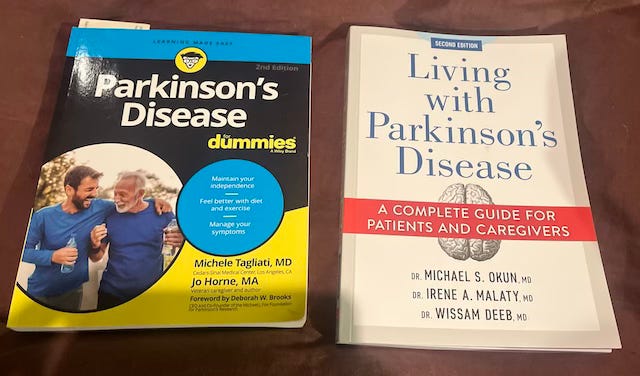
LAST WEEK I was diagnosed with Parkinson’s disease.
This did not come as a surprise. I suspected this may have been the case for well over a year. I began having mysterious tremors in my left leg around two years ago, and they progressively got worse and more disruptive to the point that I could no longer sit upright comfortably in a chair. Almost all of the work and writing I have done for the past year-plus has been in bed. Other than walking, lying in bed with my leg outstretched and fully supported (or sitting on a sofa with my leg fully supported by an ottoman) is the only position that does not trigger leg tremors. My leg hates to hang.
Mind you, working from bed – especially if you are me – is not a great hardship. It’s cozy, my dog often joins me, and when naptime comes around all I have to do is set aside my laptop and notebooks and rest my weary head on my pillow and presto – I’m out.
I do miss my more proper office setup, with a desk and faux-Aeron chair and a big honking desktop computer, plus a view of the back forty (meters, not acres). I miss all the office accoutrements and instant access to the contents of my desk: pads, pens, pencils, scissors, markers, highlighters, paper clips, file folders, filing cabinet, reference books, etc.
But that’s why God invented laptop computers, which in a pinch become portable offices. And having my office with me in bed doesn’t suck.
But having Parkinson’s does.
THE DIAGNOSIS CAME as something of a relief, as it explained an entire mysterious constellation of symptoms. On their own, any of them could be explained away easily without reference to Parkinson’s. But together with the annoying, disruptive tremors, things like a wobbly gait, unexplained fatigue, brain fog, loss of short-term memory, orthostatic hypotension (a sudden drop in blood pressure that happens when you change positions), loss of fine motor coordination, and a softening of one’s voice all add up to the collection of symptoms we call Parkinson’s.
Those symptoms alone do not make for a final diagnosis. They do, however, indicate the need for further research in the form of brain scans – two, in my case, including a regular MRI and a more complex DAT scan. While the MRI was clean, the DAT scan did reveal a small but significant area of my brain that no longer produces or plays host to dopamine, and that there is the problem. I’m not a doctor or a scientist – I’m just a rock critic who has read Parkinson’s Disease for Dummies – so I won’t go into details about the dopamine system and how essential it is to our well-being. Suffice it to say that you want a brain fully bathed in dopamine, and when it’s not, that’s when trouble begins.
My father had Parkinson’s toward the end of his life – if I recall correctly, he succumbed in his late-70s or early-80s. Scientists are not quite sure of the role of genetics in Parkinson’s, because plenty of PWPs (people with Parkinson’s) do not have family history of the disease. But there does seem to be some more likelihood that you may get it if there is a family history. And although my father was a lot older than I am (I turned 66 yesterday) when he was diagnosed, doctors now believe Parkinson’s begins to develop years before it fully manifests. And not just a few years – perhaps even ten or twenty years. In my case, the unexplained, sudden, total loss of my sense of smell about fourteen years ago was, in hindsight, a harbinger of things to come. Many PWPs lose their sense of smell, like I did, years before any other indication of Parkinson’s becomes manifest.
So now what?
THERE IS, as of yet, no cure for Parkinson’s. It’s a progressive and potentially debilitating disease whose symptoms can, for a period of time (two, five, ten, or twenty years – place your bets now), be relieved by medication that tries to replace your brain’s missing dopamine. There are also a few alternative treatments, including something called Deep Brain Stimulation, which, as I understand it, is kind of like installing a pacemaker in your brain, one that periodically jolts your gray matter with electric pulses. That requires brain surgery – literally drilling through your skull and installing a metal box and circuitry that doesn’t play well when you go through airport security – so it’s not a commonly chosen option, but rather a last resort when the drug-based interventions no longer do the job.
For now, I am in the earliest stages of taking the lowest dose of the introductory medication. It’s way too early to draw any conclusions, but I felt pretty good yesterday. Today seems like another good day. I am almost wholly focused on the present and the days and weeks and maybe months to come, but I try not to think too much about the long-term ramifications of the condition. That’s partly a strategy for coping but also recommended because the course of the affliction varies wildly from patient to patient. My individual journey will be entirely different from my father’s or from your uncle Jake’s or from your next-door neighbor’s or from your next-door-neighbor’s uncle Jake.
And as far as the timing goes, I can’t think of a “better” time to get Parkinson’s than right now, when Parkinson’s is a major plot point (spoiler alert!) on the brilliant, funny AppleTV series Shrinking, starring Harrison Ford as a charming psychotherapist forced into retirement by the advanced progression of his disease. Ford’s character has a catchphrase that helps him deal with his Parkinson’s, and it is one I am adopting for my own: Fuck Parkinson’s.
In solidarity,
“Well, I don’t want to go on the roof.” -- George Harrison

Hey, did you like this edition of Everything Is Broken? If so, please consider clicking on the “LIKE” button at the very end of this message. It matters to the gods of Substack.
Roll Call: Founding Members
Anne Fredericks
Anonymous (9)
Susan Bang
Erik Bruun
Jane & Andy Cohen
Jeffrey N. Cohen
Nadine Habousha Cohen
Fred Collins
Ian Feldman
Fluffforager
Benno Friedman
Amy and Howard Friedner
Mark & Melissa Greenlaw
Jackie and Larry Horn
Richard Koplin
Paul Paradiso
Steve and Helice Picheny
David Rubman
Spencertown Academy Arts Center
Elisa Spungen and Rob Bildner/Berkshires Farm Table Cookbook
Julie Abraham Stone
Mary Herr Tally
Daniel Wollman and Debra Pollack
I'm very sorry to hear of your diagnosis, Seth. I remember my uncle having it many years ago and it wasn't fun for anyone, least of all him. Since I've never heard of a "cure" for it, I hope it and you go on forever, even if it's in bed with your computer by your side. And a dog as well. I'm sure there are worse things.
Brief personal commentary;
Diagnosed five years back - keeping the Levodoa manufacturers in business
I choose faith over futility